
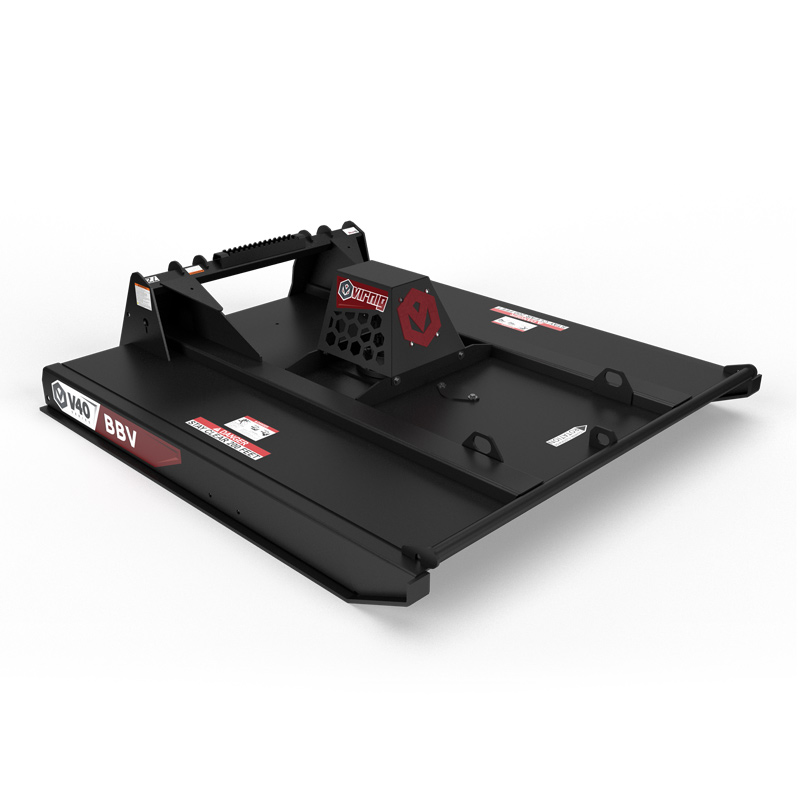
Virnig V40 Closed Front Rotary Brush Cutter

Virnig V40 Closed Front Rotary Brush Cutter

Cuts up to 3″ diameter trees and clears grass and brush for a consistent finished look.

  • DIRECT DRIVE EATON® MOTOR WITH RELIEF VALVES
  • HYDRAULIC BRAKING STOPS FLYWHEEL IN LESS THAN 10 SECONDS
  • STANDARD MOTOR GUARD & SPINDLE GUARD
  • CIRCULAR FLYWHEEL WITH 3 UPDRAFT BLADES BOUNCES OFF STUMPS

DO NOT OPERATE CUTTER WITHOUT A SHATTERPROOF CAB ON LOADER.

This field is for validation purposes and should be left unchanged.
Name(Required)
Address(Required)

Thanks for downloading

Before your download begins, please fill out the form below.

Videos
Specifications
ModelBBV60BBV72
Cut Width60.0 in / 1524 mm72.0 in / 1829 mm
Overall Width66.0 in / 1676 mm78.0 in / 1981 mm
Overall Height21.4 in / 544 mm
Overall Depth74.0 in / 1880 mm86.0 in / 2184 mm
Deck Height7.7 in / 196 mm
Minimum Cut Height1.9 in / 48 mm
Cutting Capacity, Diameter3.0 in / 76 mm
Deck Thickness¹: Top & Side0.19 & 0.25 in / 5 & 6 mm
Recommended Flow Rate16–25 GPM / 61–95 L/min
Max Operating Pressure3500 PSI / 24.1 MPa
Approximate Weight1075 lb / 488 kg1300 lb / 590 kg
Recommended Loader CapacityGreater than 1500 lb / 680 kg

¹ Material is Grade 50 Plate (50,000 PSI / 345 MPa minimum yield strength).

Blade Tip Speeds (FPM)

Standard Flow Models

Model16 GPM Minimum20 GPM25 GPM Maximum
BBV60-259,360 FPM / 47.55 m/s11,705 FPM / 59.68 m/s14,630 FPM / 74.24 m/s
BBV72-2511,235 FPM / 57.18 m/s14,631 FPM / 74.24 m/s17,555 FPM / 89.58 m/s

Flow rates are given in gallons per minute (GPM) / litres per minute (L/min), and blade tip speeds in feet per minute (FPM) / meters per second (m/s).

FAQs

Yes, the same ½” by 4” single side updraft blades are used on both the V40 and the V50 Rotary Brush Cutters.

No. The motor is only rated for 16-25 gpm. All of the motors that Virnig uses have a zero overflow tolerance. Using the attachment at higher than rated flow will eventually cause catastrophic failure of the motor and can cause abnormal stress on the bearing spindle.

The design is similar, with the V40 Rotary Brush Cutter having no options for a Rear Roller or Swivel Casters. The steel grade and thickness and amount of weld is different in some areas as well. Virnig uses at least grade 50 steel on all attachments, and a full 1 year warranty ensures that all quality is as expected from the V50 series. See the comparison chart for more information.

The Rotary Brush Cutter is not designed to use casters or a rear roller.

Virnig V40 Rotary Brush Cutters are designed to clear undergrowth and cut small trees up to 3” in diameter.

Standard deck cutters will be better at cutting grass and mulching material while open front cutters will be better for quickly clearing brush and small trees.

No. Running the flywheel system in reverse will cause the cutter to cut poorly, easily stall, and have minimal torque.

The Rotary Brush Cutter is designed to spin counter-clockwise and takes 7-10 seconds to come to a complete stop. If the flywheel is running in reverse, slow down will be much faster and very loud.

Operating the Rotary Brush Cutter’s flywheel counter-clockwise is essential for proper operation and preventing damage to the cutter’s blades and motor.

The spindle is the most expensive performance component on a skid steer brush cutter. It is responsible for smoothly transferring power from the hydraulic motor to the flywheel and absorbing impact that could damage the hydraulic motor.

High-performance skid steer brush cutters require heavy-duty spindles to ensure reliability and productivity.

Standard pressure relief valves protect the motor and the loader’s hydraulic system from damaging pressure spikes. When the maximum pressure point is reached, the valve opens to prevent pressure from rising any further. This prevents seals or other internal components from breaking due to excessive pressure.

Skid steer brush cutters are capable of throwing debris over 200 feet and can cause serious bodily harm or death if not used with a shatterproof cab.

For efficient operation, purchase a skid steer brush cutter with a cut width that is wider than the tires or tracks of your loader.

Loader capacity should also be considered. Selecting a skid steer attachment that is too wide will add weight, volume, and surface area, all factors that could affect performance.